Custom vs Off-the-Shelf Office Furniture: What Cape Town Businesses Need to Know Before They Decide
Key Takeaways:
- Custom office furniture is not always more expensive than premium off-the-shelf alternatives
- The specification process determines value — vague briefs produce poor outcomes regardless of route
- Lead times for custom furniture require planning that most businesses leave too late
- Installation, warranty, and what happens at lease end are often overlooked until they become problems
Every office furniture decision sits somewhere on a spectrum between fully custom and fully off-the-shelf. Most businesses end up somewhere in the middle — standard task chairs, custom reception desk, catalogue storage, bespoke boardroom table, without necessarily making that choice deliberately. This article is about making it deliberately. Understanding what custom furniture actually costs, where it adds genuine value, where it does not, and what you need to know before you brief anyone.
What Custom Office Furniture Actually Means
Custom office furniture is furniture manufactured specifically for your space, your specification, and your brief. The dimensions are sized to your floor plan. The finish is chosen to match or complement your fit-out. The configuration is designed around how your team actually works. This is distinct from made-to-order furniture — where you select from a manufacturer’s existing range and choose dimensions, finishes, or upholstery from a set of options, and from standard stock furniture, which comes in fixed sizes and finishes and ships from a warehouse.
The distinction matters because the term custom is used loosely in the market. A supplier offering custom workstations may mean they will cut a standard desktop to a non-standard width. A joinery company offering custom furniture will design and manufacture from scratch to your drawings. Both are technically custom. The process, lead time, cost, and outcome are very different. When briefing suppliers, ask specifically whether the furniture is designed and manufactured from your drawings or selected and modified from an existing range. The answer determines everything else.
Where Custom Adds Genuine Value
There are specific situations where custom furniture is clearly the right choice, and others where it adds cost without proportionate benefit.
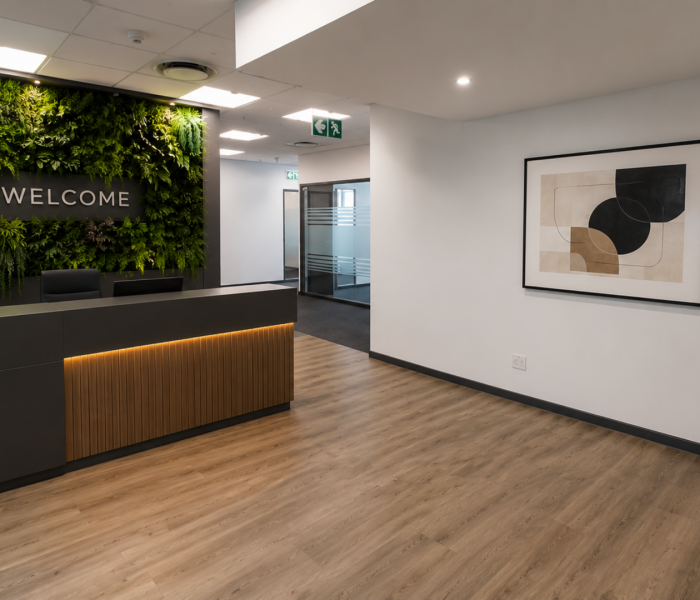
Reception and client-facing areas are the strongest case for custom. Your reception desk is the first physical thing a client touches in your office. A desk that looks like it came from a catalogue — because it did — communicates something about your business that a thoughtfully designed custom piece does not. For businesses where client perception matters, the reception area is not the place to save money on furniture.
Non-standard dimensions are a practical rather than aesthetic argument for custom. Most commercial floor plates have columns, service risers, irregular corners, or ceiling drops that standard furniture dimensions simply do not accommodate well. A workstation system that is 1,400mm deep when your bay is 1,350mm looks wrong and wastes space. Custom resolves this without compromise.
Boardrooms and meeting rooms benefit from custom tables for similar reasons to reception, the dimensions need to match the room precisely, and the table is the centrepiece of a space where client and leadership interactions happen. A table that is visually too small for the room, or that seats eleven when the room was designed for ten, undermines the space every time it is used.
Brand-aligned feature elements — a custom joinery wall behind reception, a branded feature counter, built-in shelving that integrates with the architecture — are almost always better served by custom manufacture than by assembling off-the-shelf components.
Where Off-the-Shelf Is the Smarter Choice
Custom is not always the answer. For several furniture categories, off-the-shelf commercial products are better specified, better tested, and more cost-effective than custom alternatives.
Task seating is the clearest example. A quality commercial task chair from an established manufacturer has been ergonomically engineered, tested to commercial durability standards, and is backed by a meaningful warranty and a spare parts supply chain. A custom-manufactured chair is almost always inferior on all three counts at a comparable price point. Buy task seating from reputable commercial manufacturers — Haworth, Herman Miller, Humanscale, Interstuhl, and their local equivalents rather than asking a joinery company to manufacture it.
Standard workstation systems for businesses with straightforward open-plan requirements are another category where catalogue products often outperform custom. Commercial workstation manufacturers have refined their systems over many iterations. The cable management, screen mounting, acoustic panels, and modular reconfigurability built into a well-designed workstation system are difficult and expensive to replicate from scratch.
Storage and filing is generally better served by commercial products, pedestal units, tambour cupboards, mobile storage systems — than by custom joinery, unless the storage needs to be built into a wall or integrated with the architecture in a way that standard products cannot achieve.
The practical test: if a standard product fits your space, meets your specification, and does not compromise the aesthetic of the environment, the additional cost of custom is difficult to justify.
The Cost Reality
The assumption that custom furniture is always significantly more expensive than off-the-shelf is not accurate, at least not when you are comparing like with like. The relevant comparison is not custom versus budget catalogue. It is custom versus premium commercial products at equivalent specification. When you compare a custom reception desk with a premium catalogue alternative at the same finish level, the price difference is often 15 to 25 percent rather than the 50 to 100 percent that most businesses assume.
For workstations, the comparison is more nuanced. Entry-level custom workstations can be manufactured locally at prices that compete with mid-range catalogue products. Premium custom workstations with integrated cable management, solid timber veneer, and adjustable height mechanisms will cost more than catalogue equivalents. The right answer depends on your specification.
As a working guide for current Cape Town market rates:
Custom workstations: R4,500 to R9,000 per workstation depending on size, finish, and specification. Height-adjustable frames add R3,000 to R5,000 per unit.
Custom reception desks: R15,000 to R60,000 depending on size, complexity, and materials. A straightforward laminate desk for a small office sits at the lower end. A large feature reception with solid surfaces and integrated lighting sits at the higher end.
Custom boardroom tables: R18,000 to R80,000 depending on size, material, and whether cable management and power are integrated.
Custom storage walls and joinery: R4,000 to R8,500 per linear metre depending on finish, depth, and complexity.
These are market ranges, not fixed prices. The only way to understand what your specific brief will cost is to get independent quotes from multiple suppliers working from the same specification — which is exactly the problem that vague furniture briefs create.
The Brief Is Everything
The quality of a custom furniture outcome is almost entirely determined by the quality of the brief. A vague brief: “we need a reception desk, something modern, maybe light timber” produces proposals that cannot be compared, quotes that are missing half the scope, and a finished product that is close to but not quite what you had in mind. A useful brief for custom furniture includes:
- Dimensions — the exact space the furniture needs to occupy, including ceiling height where relevant, and any architectural features that constrain the design.
- Functional requirements — what the furniture needs to do. For a reception desk: does it need integrated cable management, a raised counter for standing visitors, a lower counter for wheelchair access, storage for the receptionist, a place to charge devices, a way to conceal a desktop computer?
- Finish direction — not just “light timber” but the specific veneer, laminate, or solid material you have in mind, and how it needs to relate to the floor, ceiling, and wall finishes already specified in your fit-out.
- Budget range — giving suppliers a budget range produces better proposals than asking them to price blind. Suppliers who know the budget can make informed decisions about where to spend it. Suppliers who do not know the budget tend to pitch at the middle of their range and miss.
- Timeline — when the furniture needs to be installed, which determines when the order needs to be placed and therefore when quotes need to be approved.
The brief is also what makes multiple quotes comparable. If three suppliers are pricing against the same dimensions, the same functional requirements, and the same finish direction, the differences in their proposals are real — price, lead time, quality of manufacture, warranty. If they are each interpreting a vague brief differently, the quotes are not comparable and the process of choosing between them becomes guesswork.
Lead Times Are Longer Than Most Businesses Plan For
This is the most common practical failure in custom furniture projects. Businesses leave the furniture decision until the fit-out is nearly complete and then discover that the custom pieces they want take eight to twelve weeks to manufacture by which time the move-in date is three weeks away. Standard commercial furniture from stock: one to three weeks. Made-to-order from a manufacturer’s range: four to six weeks. Custom manufactured from drawings: six to twelve weeks depending on complexity and supplier capacity. Complex custom joinery or large feature pieces: ten to fourteen weeks.
The implication is that custom furniture decisions need to be made at the start of the fit-out process, not at the end. The drawings need to be approved and the order placed while construction is still underway, so that furniture arrives ready to install when the space is complete. If your move-in date is fixed as it usually is, work backwards from it to determine when furniture orders need to be placed, and factor that into your space planning and design timeline.
What Happens at Lease End
One question that almost no business asks when specifying custom furniture, and almost every business wishes they had, is what happens to it at lease end. Freestanding custom furniture moves with you. A custom reception desk, boardroom table, or workstation system can be disassembled, transported, and reinstalled in your next space, assuming the dimensions and configuration are compatible. This is one of the arguments for custom over built-in for furniture that you want to take with you.
Read more about our Office Reinstatement Services
Built-in custom joinery, a wall of fitted shelving, a feature counter that is fixed to the structure, cabinetry that is part of the building fabric, stays with the building. Your lease reinstatement clause will determine whether you are required to remove it at your own cost, whether the landlord will accept it, or whether it adds value to the space and can be left in place by agreement. Before you commission significant built-in custom joinery, understand your reinstatement position. The cost of removing it at lease end can be substantial.
Getting the Comparison Right
If you are sourcing custom furniture quotes in Cape Town, the brief is your control. It is what makes suppliers comparable. Without it, you are comparing different interpretations of the same vague request, which tells you very little. Get at least three quotes from suppliers working from the same specification. Check that each quote includes delivery and installation and not just manufacture. Ask about warranty terms and what the process is if something is damaged or fails within the warranty period. Ask to see completed commercial projects, not showroom samples. The difference between the right and wrong furniture supplier on a significant office project is visible every day for the length of your lease. It is worth the time to choose carefully.