

In the world of commercial real estate, the term “white box” is often used by real estate brokers and landlords to define the level of finish a space has prior to a tenant’s office remodel or tenant finish. However, it is an imprecise term. White box is often synonymous with vanilla shell, lit shell, plain vanilla shell, plain vanilla box, warm vanilla shell, warm vanilla box, warm white box and warm white shell. A typical white box space has no dry walled partitions, no electrical trunking of traditional flooring. The space may have ceilings, and a basic air-conditioning layout. Honestly speaking, every landlord has a slightly different interpretation of White Box. I have seen space that have been completely stripped out, no ceilings, no aircon, whilst certain building managers will leave basic electrical services, ceilings and aircon services. Office Space to Rent Century City There are mixed opinions on “white-boxing” a space, in an attempt to make the space more lettable. One of the obvious issues for a new tenants is that their initial set up cost will be higher than a pre-fitted out space, as two of the biggest expenses in an office fit-out is the electrical installation and air-conditioning system. The upside is that the incoming tenant has the opportunity to create the ideal office layout that offers enhanced productivity and efficiency in space utilization. Upon your lease termination, your landlord may require you to white-box the space. It is therefore important to understand exactly what the landlord requires, and what parts of your fit-out you can leave in place.
Workspace Post Covid 19
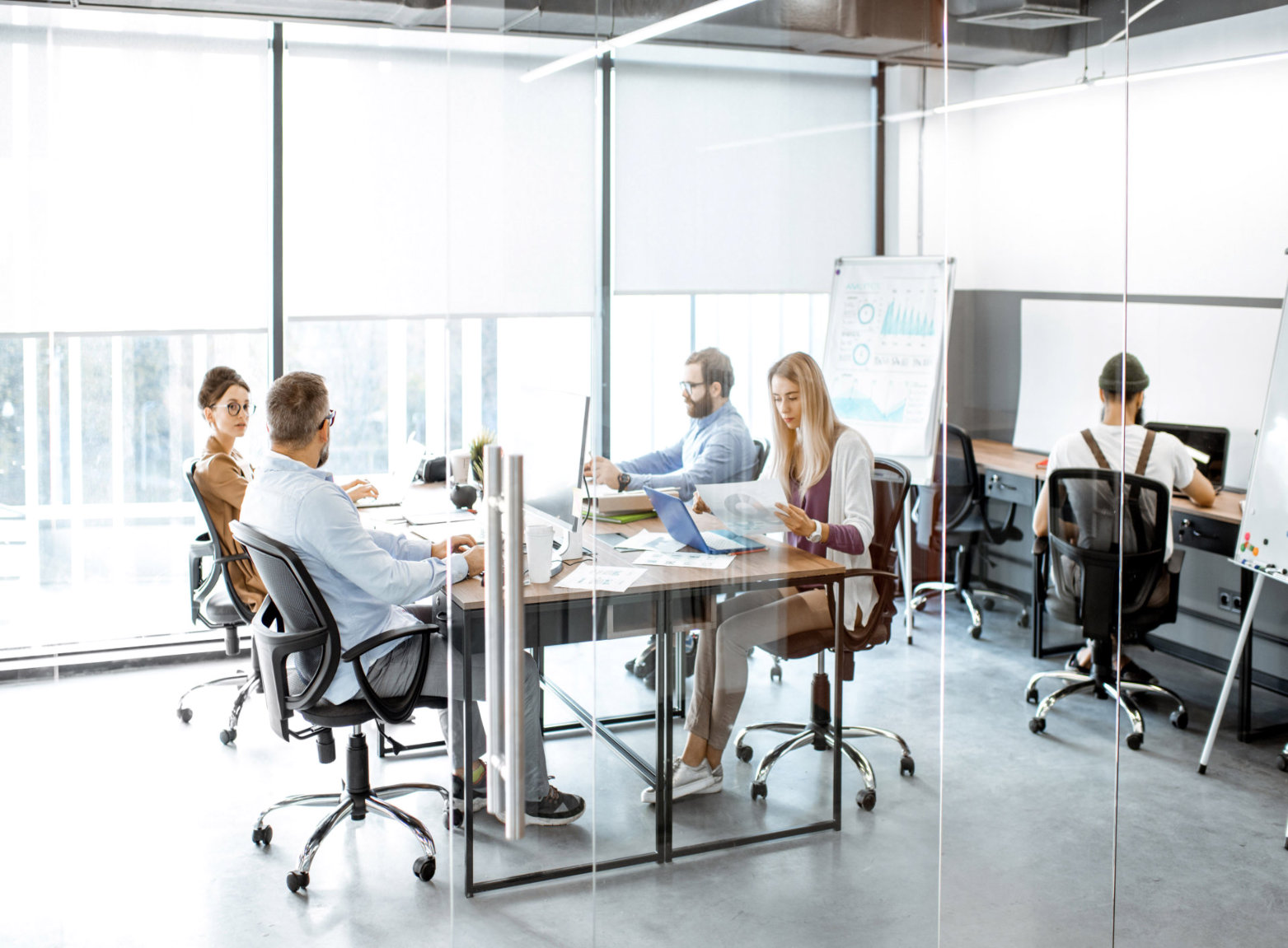
Will We Return To The Office After COVID-19 Covid-19 has forced the adoption of new ways of working. Business needs to re imagine their work and the role of offices in creating safe, productive, and enjoyable jobs and lives for employees. Many companies around the world have risen to the occasion, acting swiftly to safeguard employees and move towards a new way of working that even the most extreme business-continuity plans had not envisioned. The corona-virus pandemic has had an indelible impact upon many of the habits and customs that underpin our society, with few places as disrupted as the workplace, where legions of us have been confined to our homes where we’ve attempted to maintain business as usual to the best of our abilities. The first casualties of the shift to home working has been the traditional 9-5 office hours. With many of us juggling home and family responsibilities, especially with school closures placing expectations of home schooling onto working parents, going to the office is a luxury many can no longer afford. Are these changes likely to stick when we’re no longer confined to our homes by government regulations? A survey of real estate professionals by CoreNet Global suggests the industry believes that workers will return to offices, albeit in waves rather than all at once. Before the pandemic, the conventional wisdom had been that offices were critical to productivity, culture, and winning the war for talent. Companies competed intensely for prime office space in major urban centers around the world, and many focused on solutions that were seen to promote collaboration. During the pandemic, many people have been surprised by how quickly and effectively technologies for videoconferencing and other forms of digital collaboration were adopted. For many, the results have been better than imagined. Remote working has become a necessity for the majority of office staff, and it’s shown businesses that it is possible to maintain productivity and communication within the business unit. Workspace of the Future For years, offices have crammed more employees into smaller spaces, while creating an open collaborative atmosphere. As companies plan to bring their workforce together again in the office, numerous calculations are being made to provide an environment that will keep workers safe, healthy and productive. Among the changes being considered: wider corridors with one-way foot traffic, better air filtration, touch less elevator controls, antimicrobial materials in new construction and videoconferencing, even within the office, to avoid the conference room. Most companies are only just beginning to think about how they might change their corporate work-spaces, with some experts saying the open floor plan could be redone with better consideration for personal space and stricter cleaning schedules. Others, however, say the pandemic is the final straw for the open office. Getting back to work is not just about floor plans, but about a dramatic shift in office life as we know it. Impact on Productivity and Building Cost As both a design trend and a cost-saving measure, open office arrangements have become increasingly common. The modern concept was made popular by early 20th-century architect Frank Lloyd Wright, who believed the design would democratize the workplace by tearing down walls both literally and socially. Eighty years later, designers and architects tout similar benefits, saying the open environment allows employees to collaborate more easily. In addition to desk arrangements, designers and business will have to consider all the spaces that people move through in an office—both open and sectioned off. special care will need to be taken with regards to common or shared areas, like canteens, water station and bathrooms. Shared desks and meeting places An uptick in remote work and a reorientation of office layouts will also catalyze the need for more flexible formats, including the transformation of private work-spaces into ones that multiple employees can share. Consideration must be given to additional health and hygiene standards. The office also will become the main hub for staff meetings and group interaction and this will require substantial additional space for conference rooms, conversation hubs, and flexible private areas of all sizes. Conclusion Many businesses have already scaled back the number of employees required to be at the office, implementing various forms of agile working and schedules. Certain companies may find in the long run that this has a positive effect on productivity, taking into consideration the amount of time the average South African spends commuting to the office. so there coul be a shift to reducing the amount of office space required. but, it is not always just that easy, or cost effective to relocate to a smaller premises, so the answer is to re-look the way your office is set out. Re-configuring the space could work out more cost effective in the long run, and converting work space into larger, safer meeting areas. As a business you do not want to lose the personal interaction with staff totally.
Why is Office Space Planning important?
What is Space Planning, why is it important for my business? Well space planning is quite an important part of your office layout. If done correctly, you have an efficient office layout that enhances productivity, creates an environment that your staff and clients will love. Space planning also covers all your health and safety aspects, access to emergency exits, minimum HVAC requirements and number of staff allocated to a specific work area. To get your office layout plans approved, your set up needs to be compliant in these areas. Your local municipal office has specific requirements with regards to the final approval of your plans, and your project manager will handle each aspect of compliance. There are health & safety requirements mandated by legislation which include rules for fire evacuation plans, location for fire extinguishers, sprinkler systems, unblocked exits, adequate passage width, building fire alarm systems, non-combustible, flame resistant furnishings and unobstructed exit ways. Most organizations often have a policy on the minimum standards of accommodation for each staff grade. Administration staff may work in open plan offices whereas managers may have individual offices, sized on a seniority basis. In open plan, offices screens are sometimes used between desks to reduce noise and provide an element of privacy. This is increasingly becoming an important part of the office layout. The grouping of staff in teams often provides the best option for inter-communication and supervision and is a key factor in office layout design. However, where space is at a premium it may be difficult to accommodate a workgroup in a given area, and the solution often involves making space by moving others. These types of moves may be complex and disruptive as there is often a chain of events involved. It is business critical to make arrangements for possible work interruptions. Your Space planners will account for possible growth within your business and build in a contingency plan for this. Space planning is especially important in periods of high organizational growth as it can be difficult to know how many desks, meeting spaces, and resources in general a company needs to maximize space usage and employee productivity. Ideally, an organization can plan their space effectively by using utilization, occupancy data, employee feedback, and different principles of workplace design, to proactively adapt to the needs of their workforce. Space planners use a scientific approach to place desks, workstations and meeting rooms using best practice as well as historical data. Taking the time to properly plan how your available office space should be used for maximum benefit gives your business the opportunity to design it around what your people need to achieve at work. Your Space Planner will gather data about your company, its work place culture, different departments, and how they interact to design the most efficient and beautiful space that reflects your company profile.